“Multiplying job cost by 1.25 when you need a 25% profit margin quietly leaves 5% of revenue on the table.”
✓ With Service Zen
Use true margin math—Direct Cost ÷ (1 − Target Margin)—so your gross profit covers overhead and growth.
One of the most expensive mistakes in the trades is confusing markup percentage with gross profit margin. Adding a 30% markup to your costs only yields a 23.1% margin. Use the interactive calculator below to price your next job accurately.
Check your numbers in seconds, protect your margin and send a clear quote. Built for four-season trade & service teams
“Multiplying job cost by 1.25 when you need a 25% profit margin quietly leaves 5% of revenue on the table.”
Use true margin math—Direct Cost ÷ (1 − Target Margin)—so your gross profit covers overhead and growth.
“Material price hikes shrink your profit when quotes are copied from last year’s prices.”
Enter current material costs and labour hours to see both the required markup % and exact quote price.
“Calculating numbers on a scratchpad still leaves you typing up a separate estimate document.”
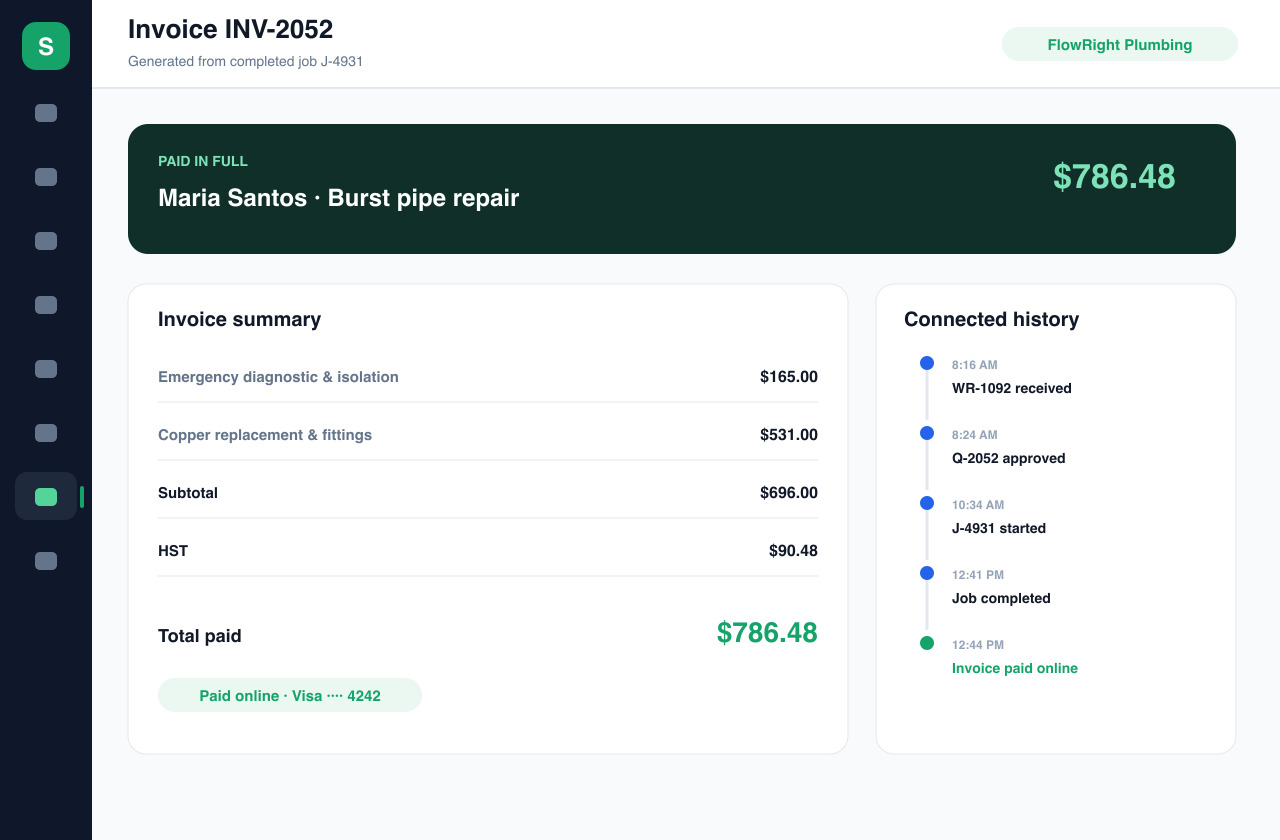
Move straight from clear pricing logic to itemized quotes, job scheduling and invoicing inside Service Zen.
A 35% profit margin is not a 35% markup. Adjust labour, materials and target margin for a markup & margin calculator job to see your exact pre-tax and tax-included quote total.
Formula: Quote Price = $600 direct cost ÷ (1 − 0.35) = $923.
Common minimum floor for large material-heavy subcontracts; leaves thin room if overhead exceeds 20%.
Healthy baseline for multi-day installations, remodels and residential project quotes ($650 cost → $1,000 quote).
Strong target for skilled trade repairs, electrical/plumbing upgrades and specialty service work ($550 cost → $1,000 quote).
Standard target for rapid diagnostic repairs, small service calls and stocked truck-part replacements ($500 cost → $1,000 quote).
Never multiply by 1.30 when you need a 30% gross margin. Use the divisor or multiplier below.
Why it matters: If your company overhead (vans, insurance, office, marketing, unbillable time) is 28% of revenue and you price jobs at a 25% markup (which is only a 20% margin), you lose 8 cents on every dollar you build.
Count all on-site hours plus prep, travel and cleanup time, multiplied by your burdened hourly labour cost.
Include fittings, fasteners, consumables and supplier delivery fees so small parts don’t erode your margin.
For a 35% gross margin on $600 of direct cost, divide $600 by 0.65 to get a $923 quote price ($323 gross profit, which is a 53.8% markup).
Put your calculated labour and material lines into a professional Service Zen quote so the client can approve online.
Margin is profit divided by the selling price; markup is profit divided by your cost. Because your cost is smaller than your selling price, your markup percentage must always be higher than your target margin percentage.
To achieve a 25% margin, apply a 33.3% markup. For a 35% margin, apply a 53.8% markup. For a 40% margin, apply a 66.7% markup. For a 50% margin, apply a 100% markup (2× cost).
When estimators and technicians build quotes inside Service Zen using structured line items, your office can review pricing before the estimate goes out or the invoice is sent.
Divide your total direct cost (labour + materials) by (1 − target margin as a decimal). For example, $500 cost at a 40% margin is $500 ÷ (1 − 0.40) = $833.33.
Margin = Markup ÷ (1 + Markup). For example, a 50% markup (0.50) equals 0.50 ÷ 1.50 = 33.3% gross profit margin.
Yes. Service Zen includes a full quoting and estimating workflow that connects approved estimates directly to job scheduling and invoicing.
Explore the live demo, test a workflow, or compare our current plans.